Introduction

1 December 2025 –
Across Japan, the number of vacant houses — known as akiyas — continues to rise, creating both challenges and opportunities for communities nationwide. As the number of intermediary services selling Japanese properties to foreigners increases, two nationwide surveys were conducted in September 2025, gathering responses from 1,000 people as well as a targeted follow-up group, to better understand how the public views foreign involvement in this sensitive issue.
The results reveal a complex landscape shaped by cultural values, caution toward outside influence, and deep concern for the future of rural Japan. While the government has introduced various measures to address akiyas, many respondents believe current efforts fall short and remain hesitant about opening the market to foreign buyers. These findings highlight not only practical worries about speculation and property management, but also broader feelings about identity, community, and the preservation of Japan’s traditional landscapes. The surveys offer a timely look at how ordinary citizens view one of Japan’s most urgent housing and regional issues.
Key Takeaways
1. A clear majority believe foreign ownership of akiyas is bad for Japan.
More than four in ten respondents view foreign ownership negatively, while only a tiny minority see any benefit. This signals a strong national instinct to protect local land, customs, and communities.
2. Selling to foreigners is overwhelmingly unpopular.
Nearly half of all respondents say they would not even consider selling an akiya to a foreign buyer — not even as a last resort. This is one of the strongest signals of protective sentiment in the entire survey.
3. The top fears: speculation, neglect, and national security.
People worry that foreign buyers may abandon or misuse properties, accelerate rural decay, or contribute to “asset outflow” and weakened local control. These anxieties combine into a powerful resistance to external ownership.
4. Deep emotional attachment to land remains a major barrier.
A substantial share of respondents express discomfort with the idea of passing inherited or ancestral land to non-Japanese owners — indicating that the issue is not just practical, but cultural and symbolic.
5. Rural decline is widely seen as alarming — but foreign buyers are not viewed as a solution.
About two-thirds are concerned about the shrinking of small towns and villages, yet this worry does not translate into openness toward foreign revitalization. Instead, people want domestic, not foreign-led restoration.
6. Government support for akiya management is seen as insufficient.
Almost 70% say current measures fall short. This dissatisfaction suggests strong public appetite for new domestic policies rather than loosening rules for overseas buyers.
7. Many feel Japan should not make it easier for foreigners to purchase or renovate akiyas.
The largest group prefers keeping the system as it is, while a large segment remains undecided — showing that people are cautious and unconvinced that foreign involvement benefits rural Japan.
8. Values and worldview drive reluctance more than media or personal experience.
In the follow-up survey, 72% say their primary concern comes from their own beliefs and value systems — indicating deeply rooted cultural instincts rather than external influence or isolated incidents.
9. Even when considering “long-term foreign residents,” most people remain cautious.
Nearly half say they might reconsider depending on circumstances, but a sizeable share still refuses entirely — meaning that cultural comfort takes priority over residency status.
10. There is strong public support for stricter local regulations on foreign ownership.
More than 80% want local governments to impose tougher rules on foreign buyers. This shows a clear appetite for stronger safeguards around land and community preservation.
Methods
To examine Japanese attitudes toward selling vacant houses (akiya) to foreigners, two surveys were conducted in 2025 via the Freeasy platform.
The first, conducted on September 5, 2025, targeted 1,000 respondents aged 20 to 99 across Japan. Participants came from a wide range of backgrounds in terms of age, gender, occupation, income, and housing status.
A follow-up survey was conducted on October 9, 2025, with 100 individuals from the initial sample who had expressed opposition to selling akiyas to foreigners. This round included both multiple-choice and open-ended questions to explore their views in greater depth.
Together, the surveys provide insight into public concerns and sentiments surrounding foreign ownership of vacant homes in Japan.
Results
Screening survey
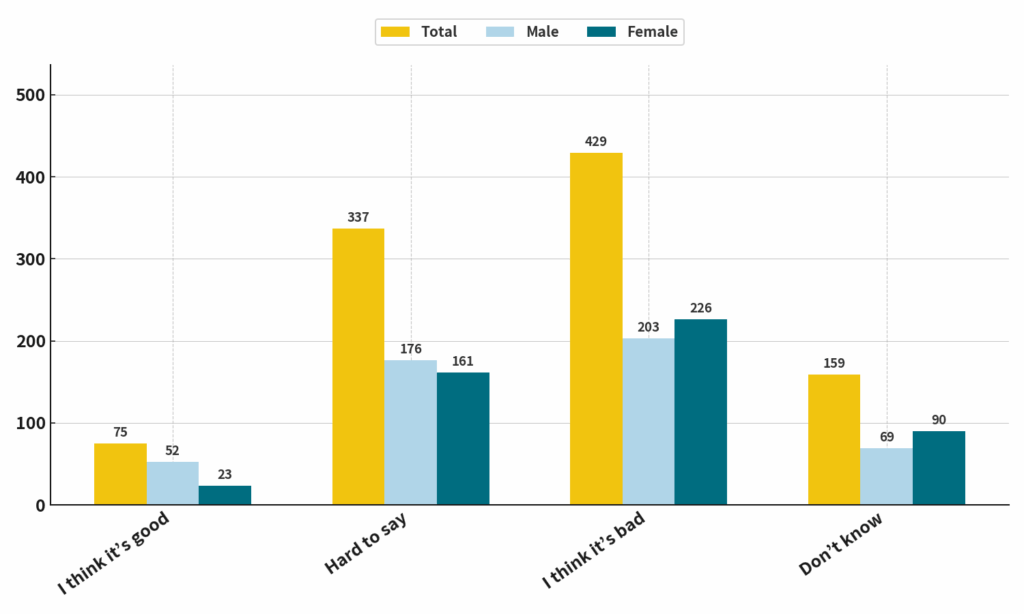
Q1 Do you think foreign ownership of vacant houses is good or bad for Japan? (SA)
n_men = 500 n_women = 500
The data indicate that the largest share of respondents believe foreign ownership of vacant houses is bad for Japan (42.9%), while about a third say it’s hard to say (33.7%) and only a small minority think it’s good (7.5%), with roughly 15.9% unsure. Overall, negativity or uncertainty dominates public opinion.
Our data shows that men are more inclined to view it positively (about 10.4% of men vs. 4.6% of women), whereas attitudes of “bad” and “hard to say” are similar across genders. No other category shows a meaningful gender gap.
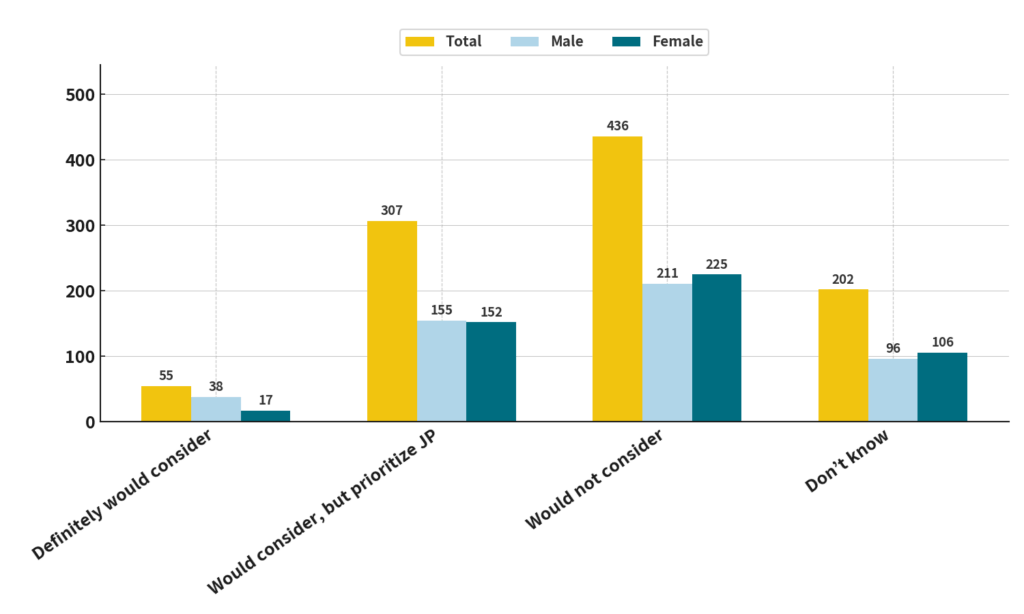
Q2 If you had a vacant house you wanted to part with, would you consider selling it to a foreigner? (SA)
n_men = 500 n_women = 500
The data indicate that the largest share (43.6%) would not consider selling a vacant house to a foreigner, while about 30.7% would consider it but prioritize Japanese buyers; roughly 20.2% are unsure, and a small minority (5.5%) would definitely consider foreign buyers. Overall, outright refusal is most common, with conditional openness far more prevalent than full enthusiasm.
Q3 What are your reasons for being reluctant or opposed to selling a vacant house to foreigners? (MA)

n_men = 366 n_women = 377
The data indicate that the leading reasons for reluctance are worries about speculation or neglect (49.9%) and concerns over national security and asset outflow (48.5%), followed by a desire to preserve local culture and customs (29.6%), fears of complicated contracts and procedures (27.9%), and resistance to passing ancestral land to foreigners (24.4%). Overall, economic and security considerations dominate respondents’ objections.
Our data shows that women are more likely than men to cite contract and procedure complexity as a concern (31.0% vs. 24.6%); no other reason differs by more than 5%.
Q4 Are you considering living in a rural area yourself? (SA)

n_men = 500 n_women = 500
The data indicate that 22.5% already live in rural areas and another 20.7% would like to if given the opportunity, while 23.3% don’t really want to and 29.2% don’t want to live there at all, with only 4.3% definitely wanting to. Overall, roughly 43% are either already rural residents or open to it, whereas about 52% express reluctance.
Our data show that women are notably more reluctant: about 26.0% of women “don’t really want” to live rurally versus 20.6% of men, and 32.4% of women “don’t want at all” compared to 26.0% of men. Other categories differ by less than 5%, indicating similar levels of interest and current residency between genders.
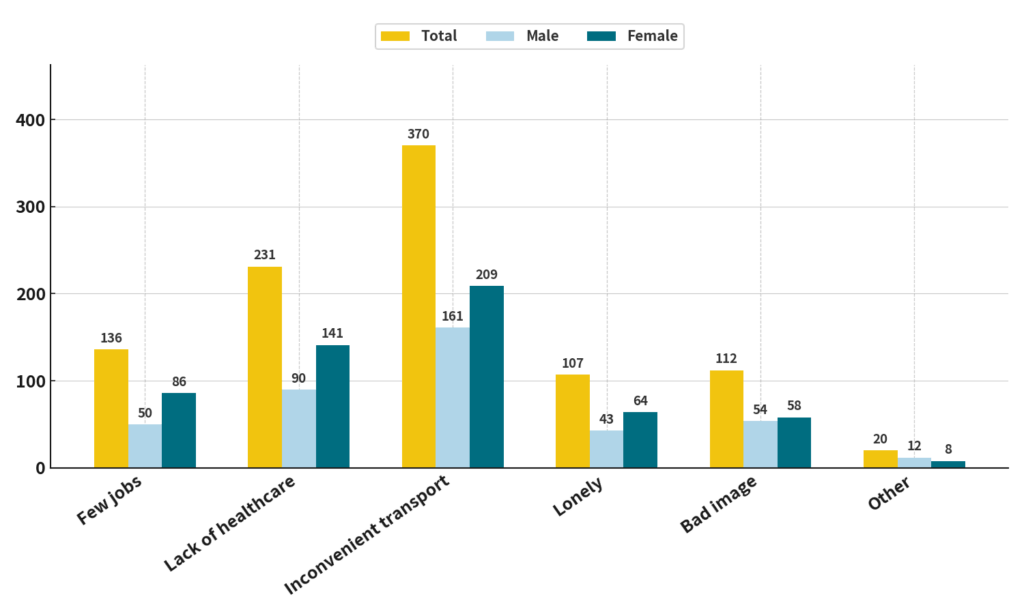
Q5 What are your reasons for not wanting to live in a rural area? (MA)
n_men = 233 n_women = 292
The data indicate that the top reasons for not wanting to live in rural areas are inconvenient transportation (about 70%), lack of medical facilities (44%), and few job opportunities (26%), followed by concerns over local culture preservation (24%), negative image (21%), and loneliness (20%). Overall, practical infrastructure issues dominate objections.
Our data shows that women are significantly more likely than men to cite lack of medical facilities (about 48% vs. 39%) and few job opportunities (about 30% vs. 22%) as reasons. Other concerns, including transportation issues and cultural resistance, show minimal gender gaps.
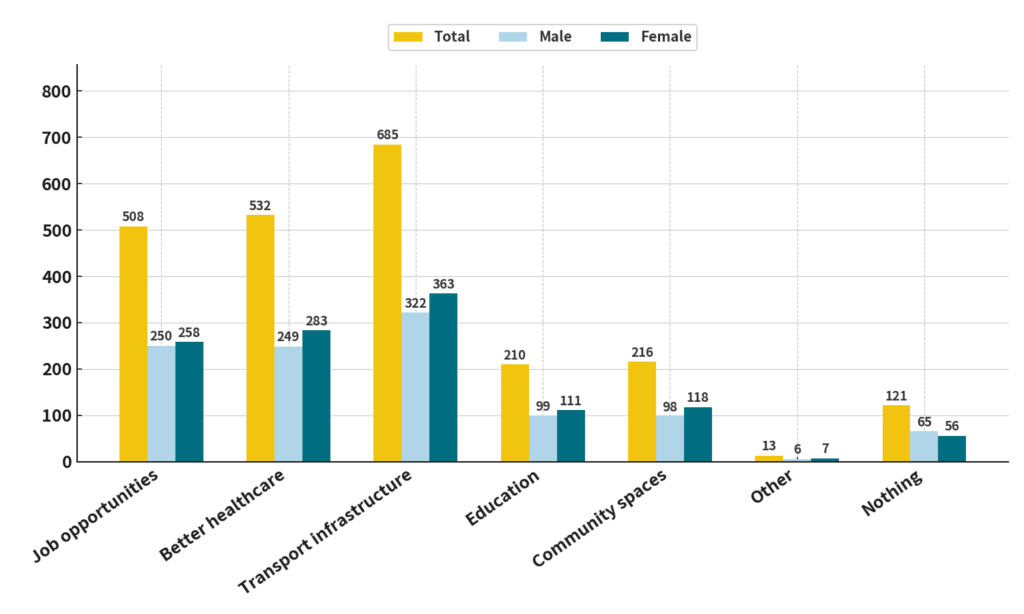
Q6 What do you feel is needed in rural areas? (MA)
n_men = 500 n_women = 500
The data indicate that the most needed improvements in rural areas are better transportation infrastructure (68.5%), improved healthcare systems (53.2%), and expanded job opportunities (50.8%), while community spaces (21.6%) and educational institutions (21%) follow, and about 12.1% see nothing in particular as needed. Overall, practical services and infrastructure top residents’ priorities.
Our data show that women place slightly more emphasis on healthcare (56.6% vs. 49.8% of men) and transportation (72.6% vs. 64.4%), whereas men more often highlight job opportunities (52.0% vs. 49.6%). Other needs show minimal gender differences.
Q7 Which do you think rural areas should prioritize: preserving traditions or modernizing infrastructure? (SA)
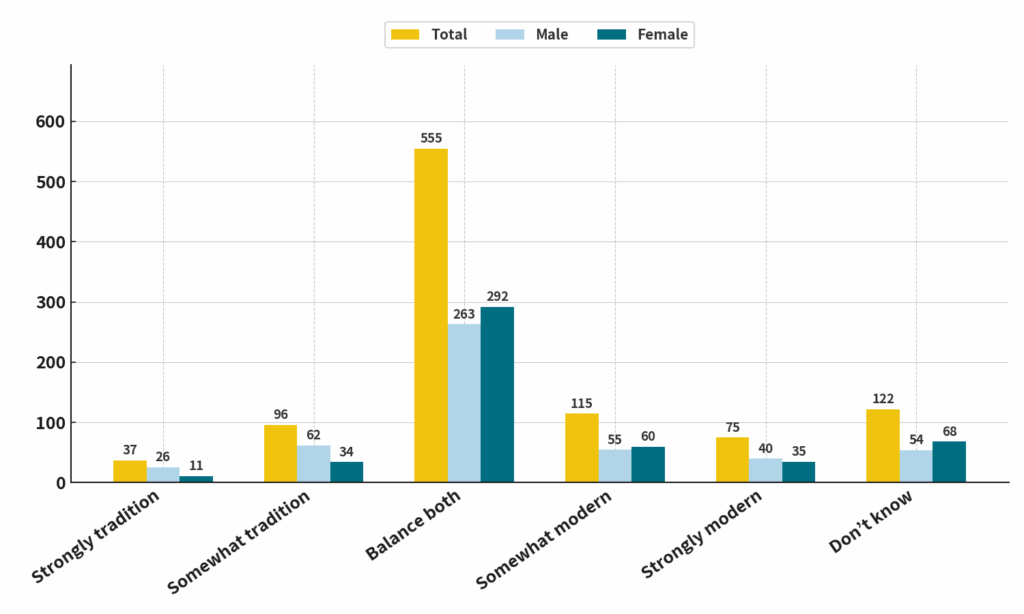
n_men = 500 n_women = 500
The data indicate that a clear majority (55.5%) favor balancing tradition and modernization in rural areas, while a smaller share lean toward modernization (about 19% combined for “somewhat” and “strongly”) and only around 13% lean toward preserving tradition. Approximately 12% are unsure. Overall, most respondents see both priorities as important rather than choosing one over the other.
Our data show that men are more inclined than women to somewhat prioritize traditions (about 12.4% of men vs. 6.8% of women), whereas women more often support a balanced approach (about 58.4% vs. 52.6% of men). Other response categories differ by less than 5% and thus reflect similar views across genders.
Q8 How concerned are you about the decline of Japan’s small towns and villages? (SA)
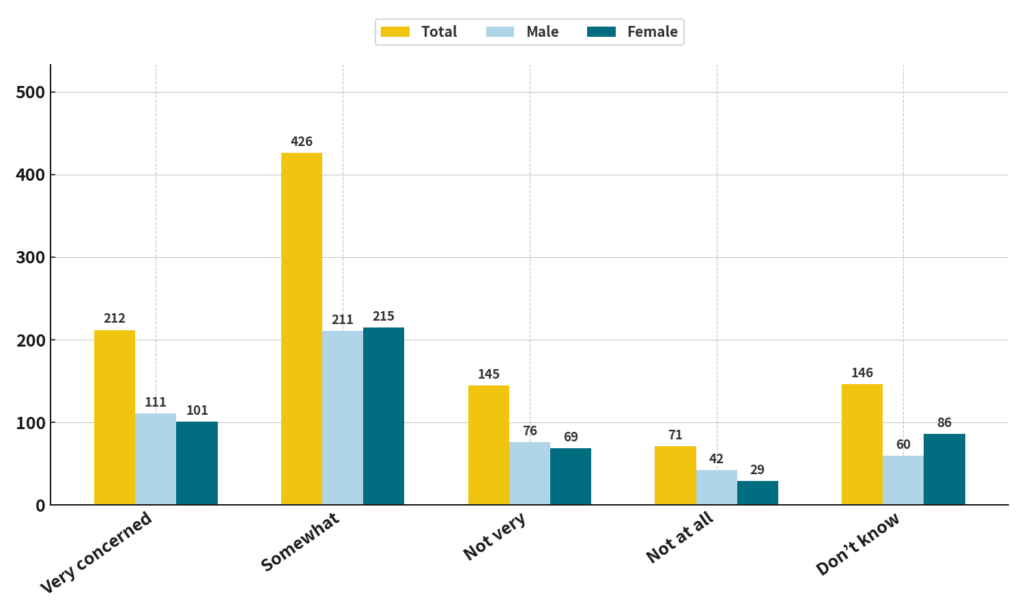
n_men = 500 n_women = 500
The data indicate that concern is widespread: about 64% are very or somewhat concerned (21% and 43%, respectively) about the decline of small towns and villages, while roughly 22% are not very or not at all concerned, and about 15% don’t know. Overall, a clear majority express at least some level of concern.
Our data show that women are significantly more likely to be uncertain (“don’t know”) at about 17% versus 12% of men. Other levels of concern are similar across genders, with no other differences reaching a meaningful threshold.
Q9 Do you think government support for vacant house measures is sufficient? (SA)
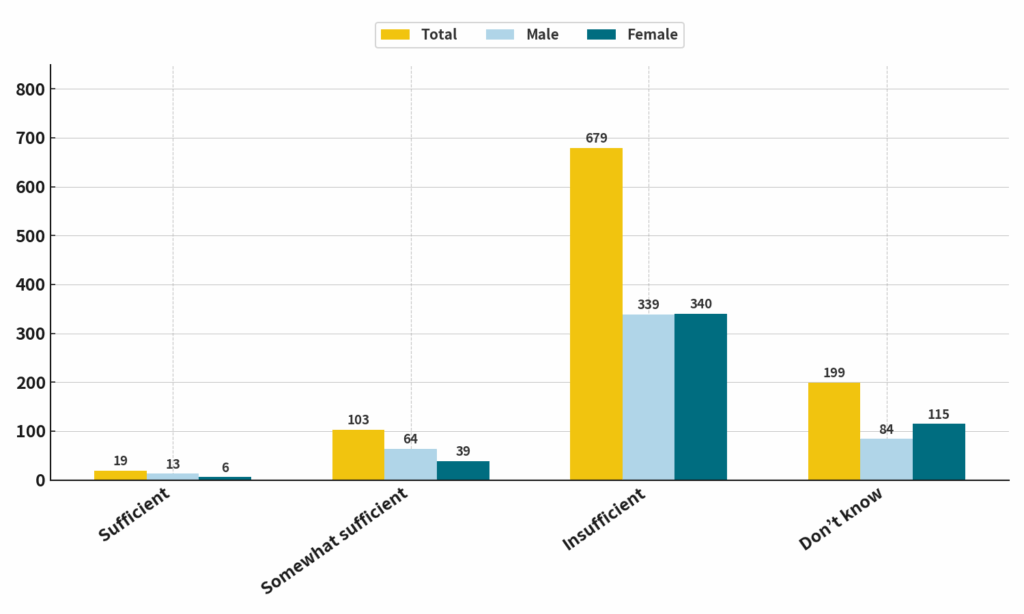
n_men = 500 n_women = 500
The data indicate that nearly 68% consider government support for vacant-house measures insufficient, while only about 12% find it sufficient or somewhat so, and roughly 20% are unsure. Overall, there’s a strong perception that current assistance falls short.
Our data show that men are more optimistic, with about 12.8% saying support is somewhat sufficient versus 7.8% of women, while women are more likely to be uncertain (approximately 23.0% vs. 16.8%). No other gender differences exceed 5%, indicating broad agreement on insufficiency.
Q10 Do you think it should be made easier for foreigners to purchase and renovate vacant houses? (SA)
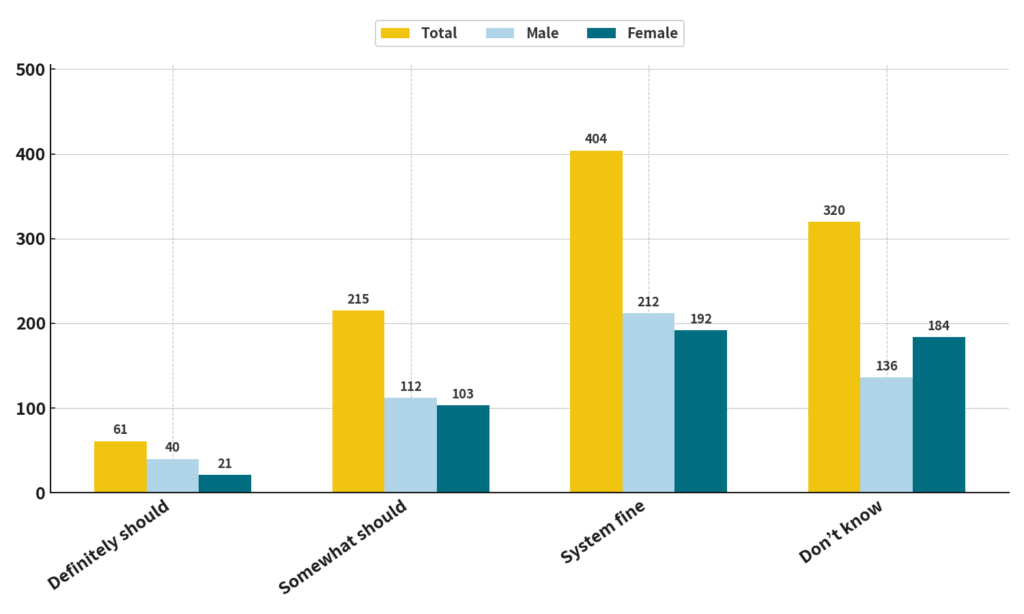
n_men = 500 n_women = 500
The data indicate that the largest group (40.4%) feels the current system is fine, about 27.6% believe it should be made easier to sell to foreigners (6.1% definitely + 21.5% somewhat), and roughly 32.0% are unsure. Overall, opinion is split between maintaining the status quo and openness, with a substantial share undecided.
Our data show that women are significantly more likely to be unsure (36.8% vs. 27.2% of men), while the proportions favoring easier foreign purchase or supporting the current system differ by less than 5%, indicating broad agreement across genders on those points.
Follow-up survey
Q1 This question is for those who previously answered “I would not consider selling a vacant house to a foreign buyer.” Please assume you own a vacant house you wish to sell and answer the following questions. (MFA)
Why would you not want to sell a vacant house to a foreigner?

The open-ended responses reveal that attitudes toward selling vacant houses to foreigners are overwhelmingly negative, with roughly two-thirds of participants expressing some form of opposition or concern. Only a handful of answers show neutral or pragmatic reasoning, such as waiting for prices to rise or seeing potential in renovation.
The most common underlying sentiment is anxiety about foreigners not adhering to Japanese social norms and community etiquette. Many respondents describe foreigners as people who “don’t follow rules” or “lack manners,” reflecting a perceived threat to the sense of order and harmony that underpins neighborhood life. This aligns with a broader pattern in which “rules, manners, and social order” form the single largest thematic cluster.
The second-most frequent concern relates to crime and safety, with respondents frequently mentioning fears that properties could be “used for crime,” become a “criminal hideout,” or contribute to a general deterioration of public safety. Cultural and language differences also rank high, as several participants cite potential communication difficulties, friction with neighbors, and incompatibility of lifestyle habits. These answers often use phrases such as “cultural differences could cause trouble,” suggesting that misunderstanding and conflict, rather than specific incidents, drive much of the unease.
A smaller yet notable group links their discomfort to national or territorial identity. These respondents worry that selling to foreigners could symbolically erode Japan’s sovereignty or cultural integrity, using expressions like “Japan’s land should belong to Japanese people” or “Japan will lose its identity.” Others object to speculative or short-term uses such as Airbnb rentals, viewing them as disruptive and profit-driven. Practical issues—language barriers in negotiation, uncertainty over post-sale use, and distrust in payment reliability—also appear, though less frequently.
Altogether, the comments reveal a spectrum of reasoning that spans emotional dislike, social conservatism, and pragmatic risk aversion, but overwhelmingly trends negative.
Q2 If the potential buyer were a foreigner who has lived in Japan long-term, would your opinion of “not wanting to sell to foreigners” change? (SA)

n_men = 44、n_women = 56
The data indicate that nearly half of respondents (46%) say they might reconsider if the foreign buyer has lived in Japan long-term, while 38% say their opinion would not change; smaller shares would definitely reconsider (8%) or are unsure (8%). The results show that conditional openness (i.e., “might reconsider depending on the situation”) is the dominant response.
Q3 Do you think local governments should impose stricter regulations on foreign ownership of vacant houses? (SA)

n_men = 44、n_women = 56
The data indicate a strong preference for tighter rules: a large majority favor either much stricter regulations (43%) or some strengthening of regulations (41%), while very few think current regulations are sufficient (6%) or unnecessary (3%). Our data shows that only a small share are unsure (7%), so overall sentiment leans clearly toward tightening local rules on foreign ownership of vacant houses.
Q4 What is the main reason for your concern about selling to foreigners? (SA)
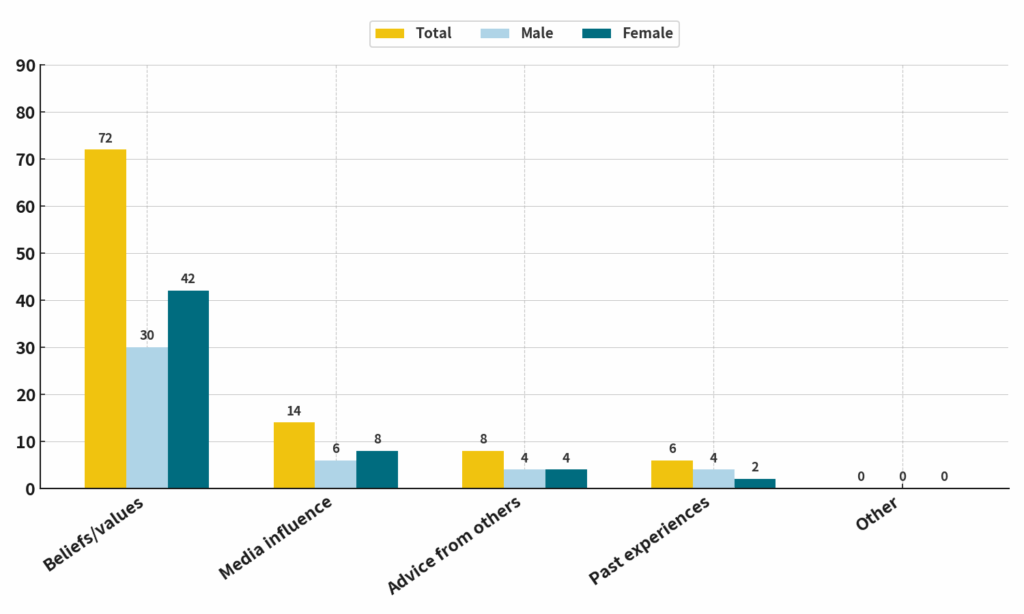
n_men = 44、n_women = 56
The data indicate that the dominant reason for reluctance is personal beliefs and values (72%), with far smaller shares attributing their concern to media/public opinion (14%), advice from family or community (8%), or past experiences (6%). Our data shows that very few respondents chose “other,” so nearly all concern is captured by those main categories.
In sum, the data illustrate that opposition to foreign ownership is not driven by a single grievance but by a complex interplay of safety concerns, social norms, and perceptions of national identity, with very limited expressions of acceptance or curiosity toward potential foreign buyers.
Conclusion
Japan’s vacant-house crisis is often described in economic terms, but these survey results show that the issue runs much deeper. For many people, akiyas are not simply unused assets — they represent family history, community identity, and the character of local towns that have existed for generations. This emotional weight helps explain why foreign ownership remains such a sensitive topic. Even as rural depopulation accelerates and small towns struggle to survive, most respondents do not see foreign buyers as part of the solution. Instead, they express strong concerns about speculation, neglect, national security, and the potential erosion of local traditions.
What emerges from this research is a picture of a country that wants revitalization, but wants it led from within. People want better infrastructure, stronger government support, and policies that help Japanese families settle, renovate, and maintain older homes. They also want rural communities to grow in ways that feel consistent with local culture and social norms. As national attention increasingly turns toward akiya countermeasures, these findings highlight the importance of understanding public sentiment. Any successful approach will need to balance revitalization with cultural preservation — ensuring that Japan’s landscapes and communities are protected for future generations.